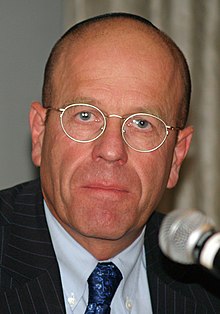
In wide-ranging interview, Former ambassador Richard Williamson says U.S. Republican candidate will make military threats against Tehran credible, arm Syria’s rebels, and visit Israel before going anywhere else.
“When Mitt Romney is president, Iran will understand that there is a new sheriff in town and that his position is that the only thing worse than the U.S. using force would be for Iran to have nuclear weapons”, according to Richard Williamson, a senior foreign policy adviser to the Republican presidential candidate.
In a wide-ranging foreign policy interview with Haaretz, Williamson blasted U.S. President Barack Obama’s “feckless and ineffective leadership” on both Iran and Syria, adding that “Iran knows there is no credible military threat from Barack Obama.”
“As Bismarck said: Diplomacy without a credible use of force is like music without instruments. And when Israel has talked about the range of options they may have to consider to protect their own interest, the Obama administration has done its best to make it difficult if not impossible for Israel to do what it must,” he added.
www.alternet.org - Israeli authorities have reneged on key provisions of the deal that ended a mass hunger strike by Palestinian prisoners last month, a new Amnesty International report on Israel’s practice of administrative detention confirms. Amnesty International, the respected human rights group, reports that Israel has placed 33 Palestinian prisoners in administrative detention since the end of the strike, despite the fact that the deal reportedly stipulated that the Israel Prison Service would not renew administrative detention unless there was “very serious” information on prisoners that would warrant the detention.
Administrative detention is the practice by which the Israeli military locks up Palestinians without charge or trial. Currently, over 300 Palestinian prisoners are being held under administrative detention, which human rights organizations say violates international law.
The Amnesty International report adds to the growing chorus of Palestinian lawyers and activists who say that Israeli prison authorities have violated the core of the deal agreed to by 2,000 prisoners who were on hunger strike.
“While most prisoners held in isolation had been returned to general prison wings, no family visits had been allowed from the Gaza Strip at the time of writing in late May,” the Amnesty report reads. “Additionally, reports that the Israeli military had by the time of writing renewed at least 30 administrative detention orders and issued at least three new ones since the deal was signed suggest that the Israeli authorities may have simply returned to ‘business as usual’ as far as administrative detention is concerned.”
The report’s appendix lists the names of prisoners who have been placed in administrative detention since May 14, the day the prisoner deal was reached. 30 of the prisoners have had their detention orders renewed, while 3 prisoners have been newly placed in administrative detention. 8 prisoners in administrative detention are members of the Palestinian Legislative Council, and another prisoner is Mohammed Ghazal, a university lecturer.
“Israel has used its system of administrative detention – intended as an exceptional measure against people posing an extreme and imminent danger to security – to trample on the human rights of detainees for decades. It is a relic that should be put out to pasture,” said Ann Harrison, Amnesty International’s Deputy Director for the Middle East and North Africa, in a statement.
The continued use of administrative detention is perhaps the most egregious violation of the deal that ended the hunger strike. But other violations have also occurred. While Amnesty reports that most of the prisoners in solitary confinement have been moved to the general prison population, one Palestinian, Dirar Abu Sisi, remains in isolation. This violates the deal, which called for an end to long-term isolation of prisoners.
Meanwhile, two Palestinian prisoners remain on hunger strike. Mahmoud Sarsak, a Palestinian soccer player, has been on hunger strike for 82 days, while Akram Rikhawi has gone without food for 58 days. Sarsak, who has been imprisoned by Israel for three years, is protesting his detention without charge or trial. Rikhawi is similarly protesting his imprisonment without being charged and tried. Both Sarsak’s and Rikhawi’s health has significantly deteriorated, and Sarsak is reportedly close to death.
Israeli forces kill three armed Palestinians and injure eight civilians in the Gaza Strip. In addition, 48 Palestinians were injured in the West Bank. Settler violence continues. Communities in the Jordan Valley continue to be affected by demolitions and evictions. Also this week, access of fire brigades to a community behind the Barrier delayed. In Gaza, people continue to experience power cuts as high as 12 hours per day throughout the week.
Occupied Jerusalem - The occupied city of Jerusalem is seeking to expand the colony of Gilo beyond Israeli-annexed east Jerusalem with 2,500 new homes in the adjacent West Bank, an Israeli lawyer said on Friday.
Daniel Seiderman, a lawyer active in the anti-colony movement, said the idea was endorsed at a city planning meeting last month.
“Ten days ago the municipal planning board deliberated on a plan to build another 2,500 units in Gilo,” he said. “The precise area is beyond the municipal... line of Gilo.”
He said the intended enlargement would be in addition to plans formally announced last month for 2,000 new homes in Gilo, which lies just a few kilometres north of Bethlehem.
The Independent - Amid the darkness surrounding the Middle East peace process, we now see a ray of light. Since 2009, the United Kingdom has been taking measures, in accordance with European consumer protection rules, to ensure that settlement products – goods you might find on your supermarket shelves that have been produced in the occupied Palestinian territories – are no longer labelled as "made in Israel".
After a meeting of the EU Council of Foreign Ministers last month, several European member states now appear ready to follow the British initiative. Denmark has already announced it will do so. Member states also committed to ensure that settlement products were excluded from preferential treatment under the EU-Israel Association Agreement.
Contrary to what you may think, EU member states which take these measures act in Israel's interest. They do so because they take steps that defend and reinforce the Green Line, the pre-1967 border between Israel and the occupied Palestinian territories.
In the last few days different actions have taken place in the village of Tuqu', south of Bethlehem. The village is threaten by the expansion of Teqoa and Noqedim illegal settlements and their connected civilian outposts . On Saturday 24th May, Palestinian farmers, Israeli and international activists reached the farmland of the village that they have been not allowed to cultivate for more than five years due to their vicinity to Teqoa D outpost. They worked the land and took care
of the olive trees and as they came closer to the outpost, a number of the settlers approached and were joined by the army, who prevented them from working. Soldiers declared the area a 'closed military zone' in order to ensure that the farmers and activists could not come close to the illegal settlement but also the private Palestinian land, but did not try to remove the settlers from private Palestinian land.
A few days later, settlers put an Israeli flag on the roof of a Palestinian house located in the farmland, whose inhabitants abandoned it due to their close proximity to the settlement and exposure to settlers' attack. The day after, the villagers together with Israeli and international activists marched to the house in order to remove the flag and found that settlers had removed it just before their arrival, so they replaced it with a Palestinian one. A small group of farmers and activists walked to the area bordered by the outpost of Teqoa D and was once again approached by settlers and by the army. As the tension arose, three Israeli activists were brutally arrested and one of them reported a hand injury. Soldiers unsuccessfully tried to arrest three Palestinians, injuring two of them, while a settler hit a elderly farmer in his stomach. The area was again proclaimed a closed military zone, so activists and farmers were chased away.
The following day, settlers organized a march on the paved road that links the eastern part of the settlement of Teqoa with Teqoa B, C and D, which encroaches on Palestinian private farmland.
On the 1st of June, the farmers returned to their land, finding that the army was positioned not far from the Palestinian house. The villagers managed to work the land around the building but were prevented from reaching the eastern part of the lands by Israeli soldiers, who threw sound bombs toward them. Villagers said they will not desist from claiming and working on their land and will return for similar actions
Supermodel Bar Refaeli was threatened by a group of fanatic Israelis not to marry a goyim (none Jew) resulted in breaking up with Leonardo DiCaprio.
Last week, a headline hit almost every newspaper in many different languages, including Arabic, that the Israeli supermodel Bar Refaeli is on top of Maxim's hottest woman in the world, though, she says ‘I don’t get hit on by guys. No one flirts with me.’
Two years ago, Rafaeli received a threating letter from Marzel, a well-known stalwart among Israel's ultra-nationalists, on behalf of an organization named "Lehava." In Hebrew, this means "flame:; it is also the Hebrew acronym for "Preventing Assimilation in the Holy Land."
Tel-Aviv, spent a fortune on labeling the city as gay paradise city to claim human rights patriotic city in the same time to cover up the occupation and settlers crimes against the Palestinians in West bank and east Jerusalem, fails its own citizen, Supermodel Bar Refaeli, on the simple human right principle of freedom to choose who to live with.